If you look out any window in NYC, you’ll see one. Stand on any rooftop, and there they are. Even down on the street, they loom large above you. In a sea of brick, concrete, glass, and steel, New York’s wooden water towers stand out. So why are they there? Why are they made of wood? And why do other cities seem to not have them?
To start our story, let’s look at what the water towers actually do. Ultimately, the water towers are just big tanks of water on the roof. They use gravity to provide water pressure to a building. The city plumbing brings water to the building, a pump brings it to the roof, and gravity does the rest.
When you turn on a faucet, the water literally falls out.
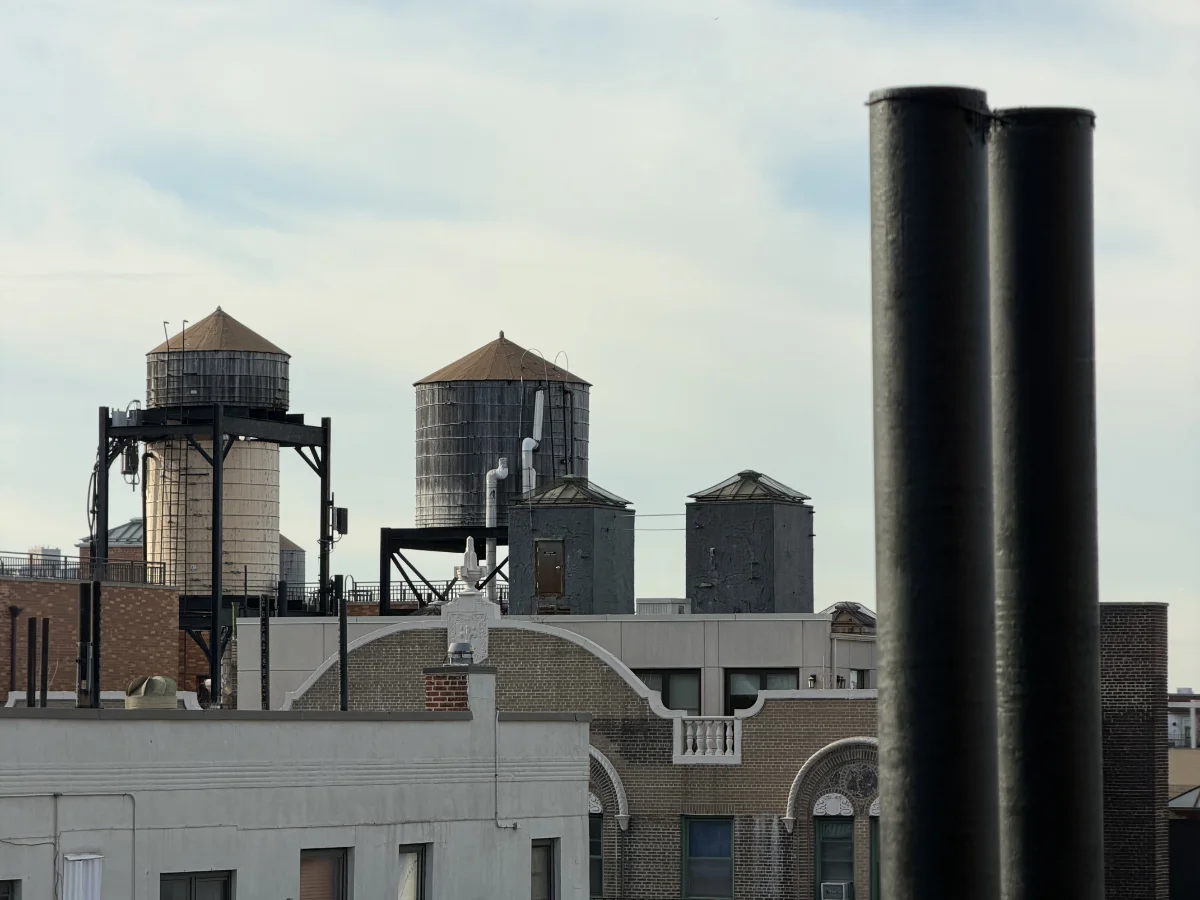
The beautiful simplicity of this system is that, as long as there is water in the tank, it works. No power required. A building can still get water even in a total blackout. This is critical for fire response, since it means that standpipes–basically in-building fire hydrants–will always have water pressure.
In fact, fire safety concerns are one of the main reasons the water towers are still around today.
But water towers can’t be the only way to get water to a building, can they? In fact, if you look out over the skyline, you’ll see that not every building has one. Only buildings above six stories tall even need water towers.
To understand why this is, you have to understand the city’s water system. The city gets its water from a series of reservoirs upstate, mostly in the Catskills.
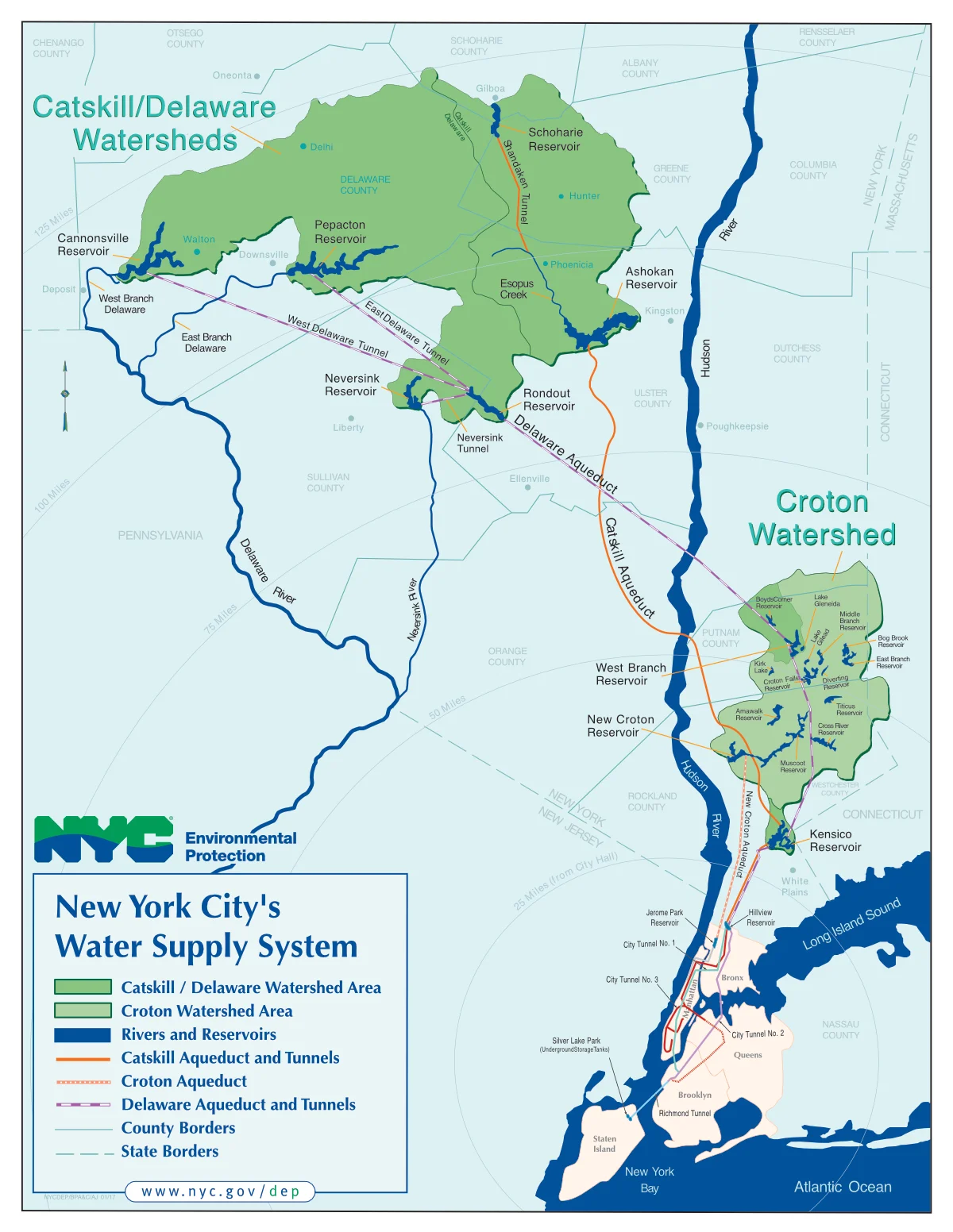
And how does that water make its way into the city? Once again, the answer is gravity. New York City has lucky geography. The reservoirs that the water comes from sit higher than any point in the city. So, just like in ancient roman times, water naturally flows from these reservoirs, through a series of pipes and aqueducts, and ultimately to every building in the city.
Gravity builds enough pressure in this system to be able to carry this water safely back up to the fifth floor of any building. This is why walkups and single family homes don’t need water towers,. When you turn on the faucet in your fifth floor walkup, the only reason water comes out is because your apartment is lower than a reservoir upstate.
The first version of this water system was built in the 1840s, before there were any tall buildings in NYC. But as the 1800s progressed, the city started building taller. As buildings went above the limit of what the city’s water system could provide, they needed an alternative way of providing water pressure.
This is where the rooftop water tower came in. The tanks are a simple and reliable solution to a complex problem. Moreover, in addition to helping provide drinking water, they could also help fight fires.
NYC had two great fires in the 1800s which destroyed large parts of the city. As buildings became taller and denser, the fire risk only increased. Therefore, as the 19th century came to a close, and since the water tower had already become the de facto standard, city officials enshrined them in law.
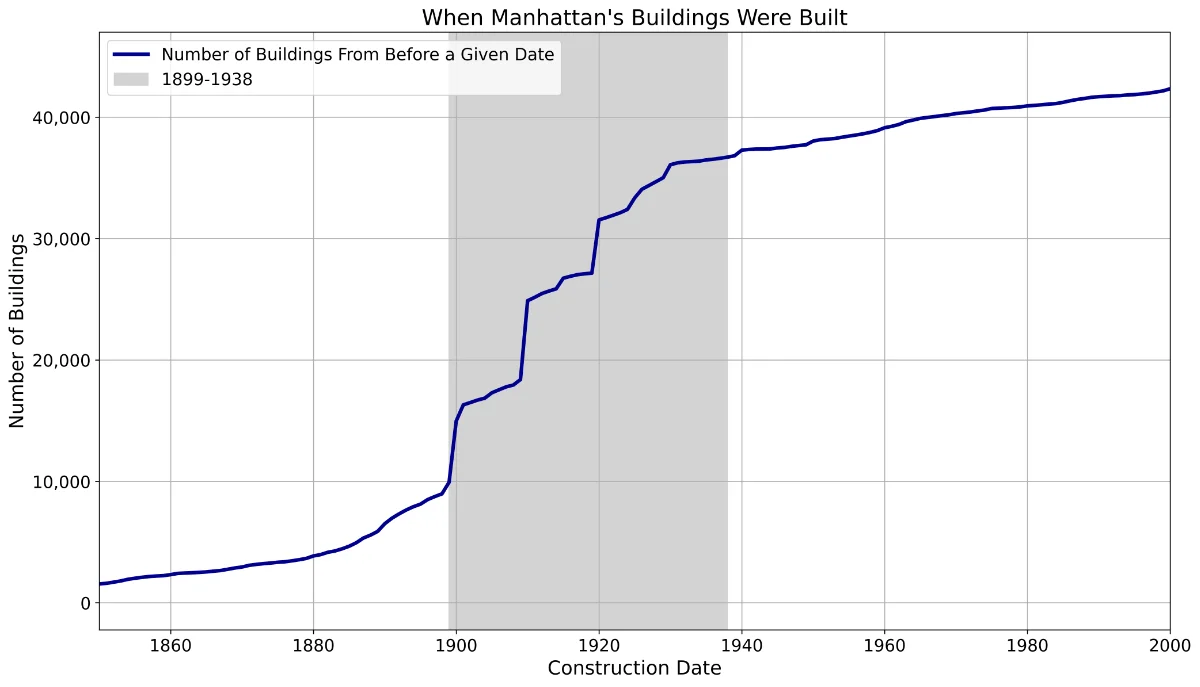
The city’s first official building code, written in 1899, explicitly called for rooftop water towers on buildings over six stories tall, citing fire safety as the reason.
The building code can cast a long shadow. It has now been almost 130 years since this original code, and we are still surrounded by water towers.
Later codes, like the 1938 building code, would repeal the explicit requirement, opting instead to specify water flow standards that could be met by a water tower among other options. But the die had been cast.
NYC went on a major building boom in the years after 1899. Nearly 60% of the buildings that currently stand in Manhattan were built between 1899 and 1938, under the guidance of that original building code.
So do water towers only exist atop New York’s many old buildings? Does this entirely explain their prevalence today? Not quite.
To understand why not, you need only to look at Hudson Yards. In the midst of this modern development stands 311 11th Ave, a 60-story glass and steel skyscraper finished in 2023. It is hard to imagine a more 21st century building in the city. But yet, on the roof, stand two wooden water towers. Clearly, these tanks still have some value today.

To complicate the story, however, not every new tall building has a water tower. There’s no rooftop water tower swinging in the wind atop 432 Park Ave. for instance. Understanding why this is will help illuminate where water towers fit in the city’s architecture.
If a building is too tall, gravity works against you. 432 Park Ave is 1,400 feet tall. If it had a normal water tower on top, with no special systems in place, that water would reach 600 PSI by the time it reached ground level. That is over 20 times as much pressure as a normal city pipe can sustain.
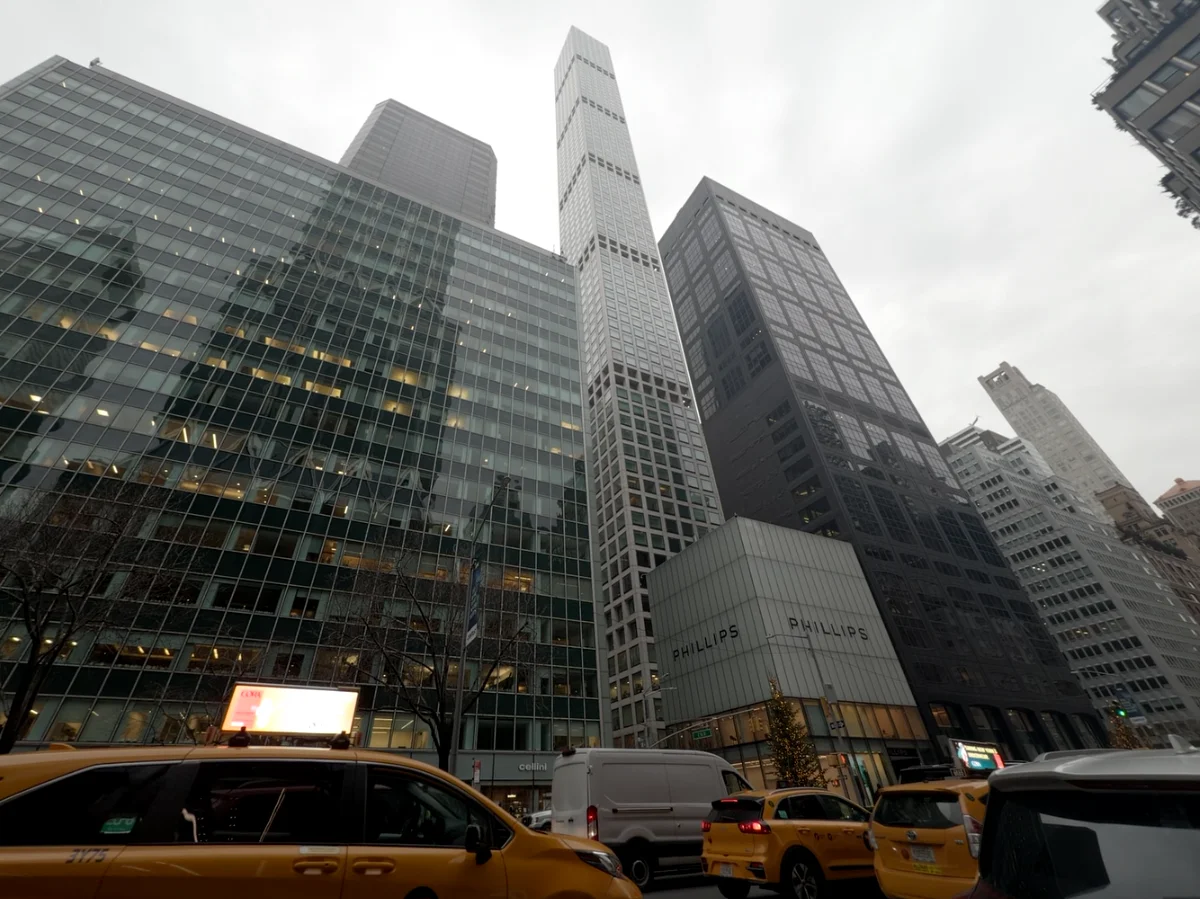
Moreover, if a building is too big, traditional water towers become unwieldy. A standard rooftop tank is about 10,000 gallons. A large modern office building like 1 Vanderbilt can use hundreds of thousands of gallons per day. At that scale, additional engineering is required.
For a run of the mill 12-story building, however? 10,000 gallons is more than plenty, and at less than 200 feet tall, the pressure never becomes extreme. This style of mid rise building is perfectly suited for a water tower.
This might also explain why other cities don’t have as many water towers. Chicago is a great example. In many ways, Chicago and New York followed similar trajectories. Chicago boomed as a city around the same time NYC did. Chicago built some of the world’s first truly tall buildings. And Chicago did have rooftop water towers.
After the great fire of 1871, water towers started popping up all around the city. There were over 1,000 at their peak. Now there are only around 100 left.
Ultimately, this comes down to the fact that Chicago doesn’t have that many buildings in that 6 to 12 story sweet spot. By contrast, Manhattan alone has over 10,000 such buildings. This meant NYC built and maintained a skill set around water towers, which Chicago lost in favor of other water distribution methods.
That skillset is why water towers are still made of wood to this day. As unlikely as it may seem, wood continues to be the cheapest and easiest material to build these tanks out of. The tanks are wooden barrels, which can be assembled on site, in a single day, for less than a fourth the cost of a comparable steel tank. And, unlike steel, wood insulates, making the water inside less likely to freeze.
But wood is not without its downsides. In 2014, the New York Times ran an expose on the hidden dangers of water towers. If they are not maintained, the wood inside can rot away; leaving holes for animals and sludge to get in.
The Times found multiple instances of tanks filled with mud and sediment. In the worst case, the found e-coli.
The city mandates yearly inspections of water towers, and the results of those inspections are now available online. If you want to look up your own building, you can do it here.
Ultimately, most of the problems with a wooden tank can be resolved by regular inspections and maintenance. The tanks are only meant to last 30 years, after all.
Water quality may also be an increasingly moot point, as not every water tower is used for drinking water any more. Instead, as the years have progressed, more buildings have switched to pump based systems, reserving their water towers only for fire emergencies.
In the end, why should we care about the water towers? Well, I think we should care because the story of the water towers is a microcosm of the history of NYC. They tell the story of an early growing city. As the population expanded, there was a deep need for water. They tell the story of the city’s quest to grow ever taller. They tell the story of how fire risk was one of the biggest constraints in how the city could build. And finally, they tell the story of the long felt impact of building codes on the city’s aesthetic.
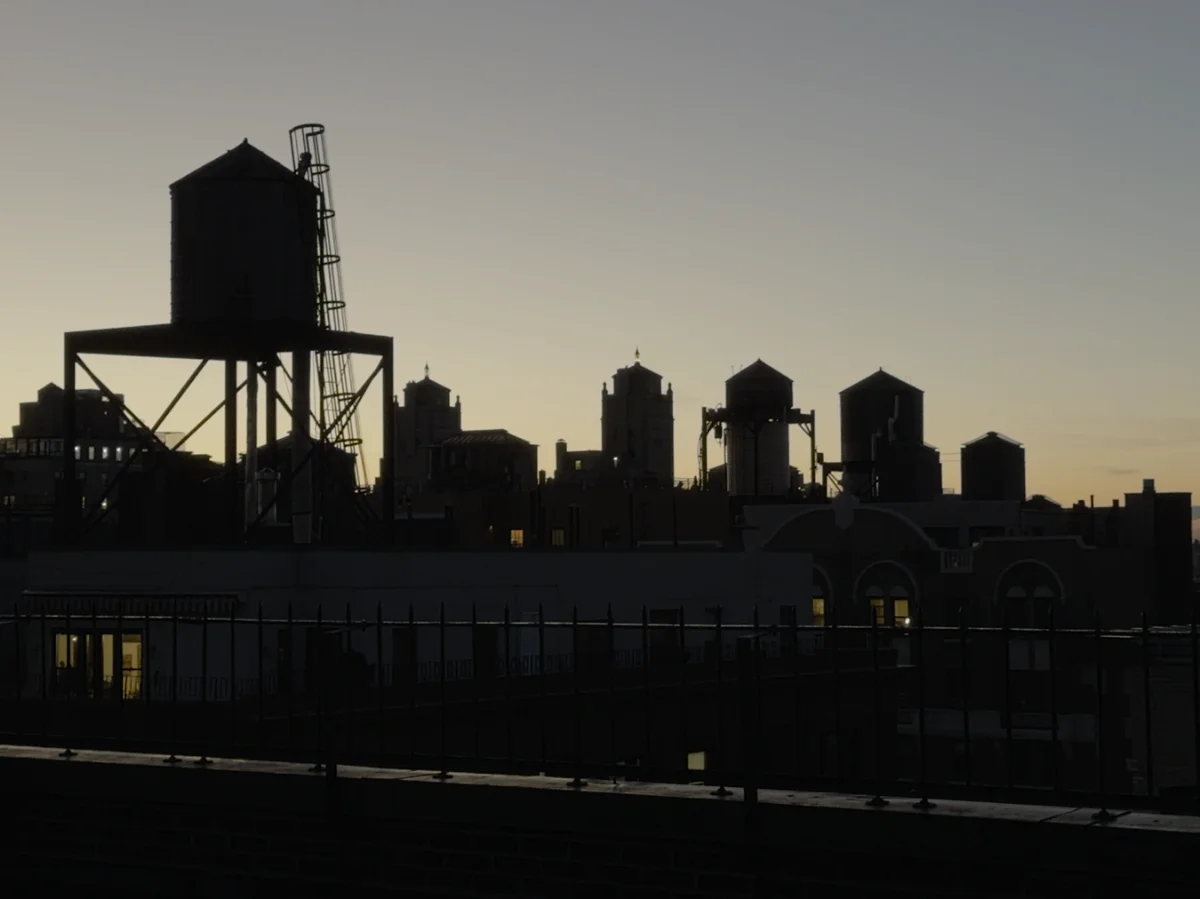
But most of all, I simply think the water towers are one of the most clearly defined features of the city’s landscape. When you see hundreds of rooftops covered in water towers, where else could you be but New York?
In conclusion, below is a 1929 NY Times article on water towers:
“Now that New York is behaving like Alice in Wonderland and finding ever new combinations of stone and steel to raise its collective head a little nearer the clouds of the upper air, a close acquaintance with a long-overlooked feature of the city’s skyline—the water towers—comes eventually to be almost the dominant feature of the landscape.
The eye at first may search the azure of the sky and perhaps glory in what a sunset is able to achieve with the New Jersey horizon; and, as time elapses, may dwell on the fine points of the surrounding architecture. Yet, about the time one’s eye has become familiar with these sights, and has made the studies in human nature presented by the windows in the buildings opposite, he begins to find his most important thought broken into with the irreverent discovery that the water tower across the way badly needs painting. And from then on, willy-nilly, he takes to observing these objects until, like Mark Twain’s unfortunate conductor with his jingle, he cannot dismiss the idea; and every tall building becomes to him just another pedestal for a water tower.“