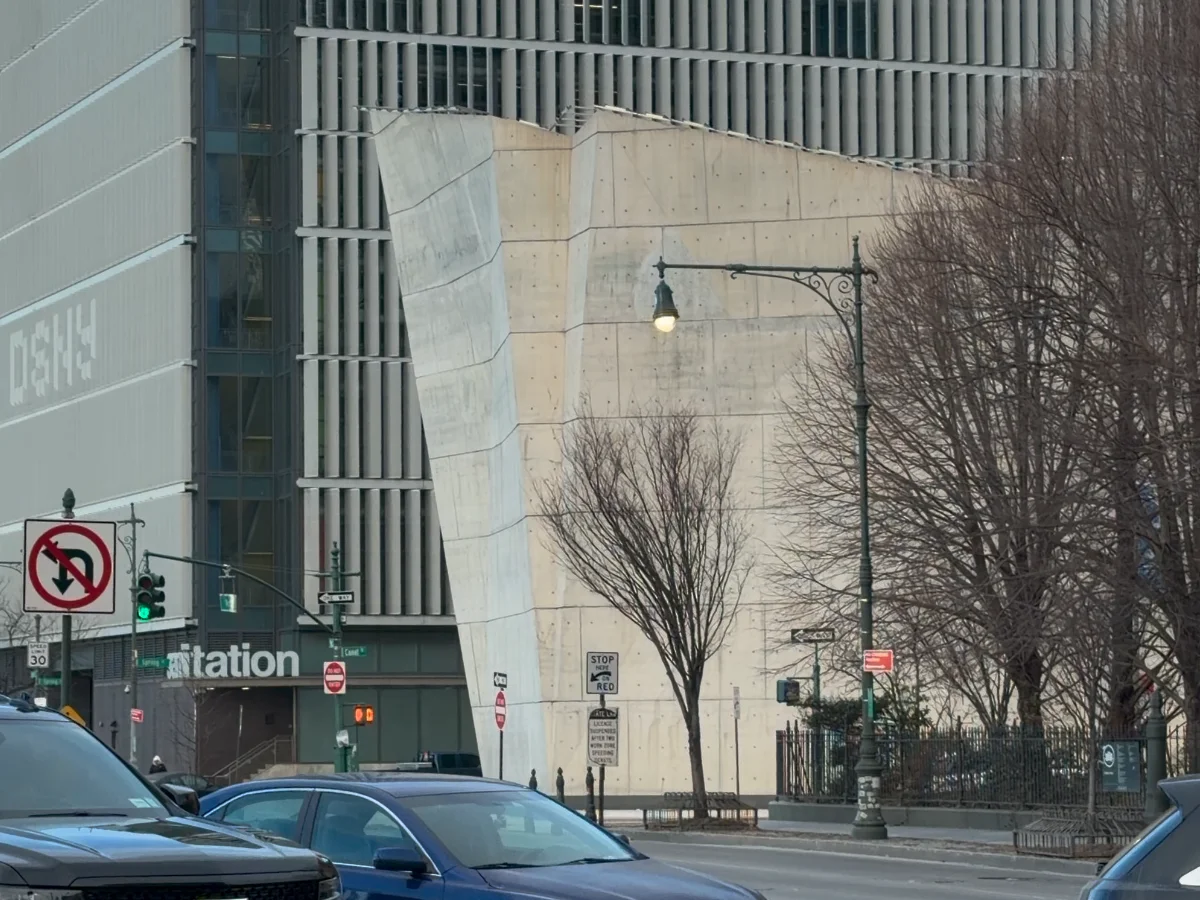
But it’s not just any salt shed, it’s the Spring Street shed.
Every winter, an army of salt spreaders descends on New York City. The Department of Sanitation operates around 40 sheds like this one, stocked with salt hauled from mines as far away as Chile.
When snow starts to fall, that salt is spread across nearly 6,000 miles of city streets, melting ice and giving commuters just enough friction to keep the city moving.
In heavy winters, New York deploys nearly 400 salt spreaders across the five boroughs, burning through hundreds of thousands of pounds of salt to keep streets passable. This shed alone, the Spring Street shed, houses 10 million pounds of it.

And for a building whose job is storing road salt, you might notice something unexpected: it is kind of beautiful.
That is intentional. Instead of hiding the structure, the city leaned in and turned infrastructure into architecture. The Spring Street shed is designed to resemble a salt crystal, with walls up to six feet thick, built to withstand corrosion, storms, and time itself.
Its glass base makes the building appear to float on water, mirroring the Hudson right beside it.
Its designer once joked that he imagined humans stumbling upon it in some distant future and wondering: why did these people worship salt?
The Spring Street shed is proof that even the most utilitarian parts of the city can be built with care and with beauty, while still serving a critical function: managing winter ice safely and predictably.